Flood-MAR (Flood-Managed Aquifer Recharge) uses excess water from high-flow events to replenish groundwater supplies by directing it onto suitable agricultural lands, working landscapes, and managed natural areas where it can safely infiltrate into aquifers.
This innovative approach can help California reduce flood risk, improve water supply reliability, support ecosystems and agriculture, and build resilience to climate change. Because these benefits span communities, landscapes, and sectors, advancing Flood-MAR requires strong partnerships and collaboration across California.
That's where the Flood-MAR Network comes in: connecting people, sharing knowledge, and accelerating the partnerships needed to advance Flood-MAR across the state.
The Department of Water Resources (DWR) and its State, federal, and local partners are actively preparing for a possibly wet season under very strong El Niño conditions.DWR is using the most advanced forecasting tools with partners at NOAA, Scripps, and others to prepare water managers for whatever may come in the months ahead. Mike Anderson, the State Climatologist with DWR, will present what current forecasts are telling us about the wet season ahead and Mike Mierzwa, the State Floodplain Manager also with DWR, will share guidance about how to prepare for flood conditions and document flood thresholds for advancing activities that reduce flood risk while increasing recharge under CWC Section 1242.1.
Links and Resources:
Presenters: Mike Anderson and Mike Mierzwa, DWR
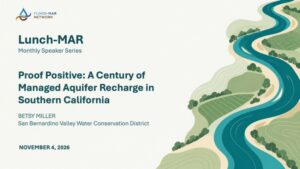
What is managed aquifer recharge really worth? Join us as we explore the economics of MAR, from the costs and benefits identified across the research literature to new insights from the Kern Water Bank. This session will preview a forthcoming synthesis report and present an empirical case study using agricultural land values to estimate the economic value of groundwater storage and banking for landowners.
Presenter: Ellen Bruno, UC Berkeley
Wednesday, October 7, 2026, 12:30PM -1:30PM PT
Very strong El Niño conditions are expected to develop this year. Understanding available forecasting tools will help water managers prepare for an active wet season. Brian Kawzenuk, with the Center for Western Weather and Water Extremes, will share information on atmospheric river forecasting toolsand Mike Mierzwa, with the California Department of Water Resources, will share how to use the California Nevada River Forecast Center website runoff and flow forecasts. These are important tools for water managers to plan for and manage potential flood events. Meagan Wylie, Flood-MAR Network Administrator, will also share the newly updated Flood-MAR Hub where a collection of resources and guidance on using floodwaters for recharge can be found.
Links and Resources:
Presenters: Brian Kawzenuk, CW3E; Mike Mierzwa, DWR; Meagan Wylie, FloodMAR Network
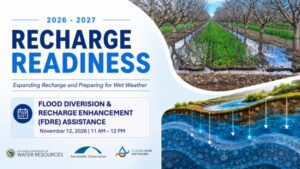
Get ready for the wet season! Join the new 2026–2027 Recharge Readiness Webinar Series, a twice-monthly webinar series (the 2nd and 4th Thursday at 11 AM) featuring the latest guidance, tools, case studies, and lessons learned to help growers, water managers, and local agencies plan and implement successful managed aquifer recharge projects. Co-hosted by DWR, Sustainable Conservation, and the Flood-MAR Network.
Here is what’s coming up next:
Three almond growers in the Turlock Irrigation District put on-farm recharge into action—collectively recharging more than 80 acre-feet of water across 67.5 acres. These case studies offer a practical look at site conditions, field infrastructure, labor needs, costs, and lessons from real-world recharge events in Stanislaus and Merced counties.
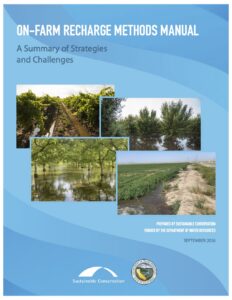
Sustainable Conservation’s On-Farm Recharge Methods Manual brings together more than a decade of grower experience to help plan and implement groundwater recharge on agricultural lands. It covers site suitability, crop health, water quality, field preparation, recharge methods, costs, and incentives, with 23 case studies illustrating practical strategies and challenges.
California’s water-planning landscape is evolving, creating new opportunities to more fully integrate groundwater recharge and Flood-MAR into statewide planning and turn that planning into action on the ground.
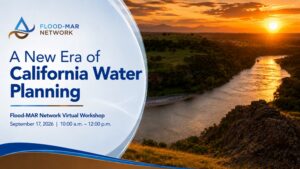
The Flood-MAR Network held an interactive virtual workshop on Sept 17. 2026, exploring what’s ahead. We herd directly from California Department of Water Resources (DWR) about how the California Water Plan is evolving, took a closer look at how Senate Bill 659 is advancing recharge within the California Water Plan, and received updates on emerging programs, technical assistance, and funding opportunities.
Interactive discussions throughout the workshop explored how the Flood-MAR Network can engage with and inform these efforts, build useful partnerships, and help move recharge opportunities toward implementation.
Whether you’re a grower, researcher, water manager, policymaker, consultant, nonprofit, Tribal representative, student, community member, or simply curious about flood-MAR, we invite you to get involved.
Copyright 2022-Present, Flood-MAR and Contributing Authors.