| Title | Groundwater Recharge Program Guidance and Recommendations for Turlock Subbasin GSAs |
|---|---|
| Resource Author(s) |
|
| Year of Publication | 2026 |
| Document Upload | Turlock-Recharge-Guidance-and-Recommendations-Technical-Memo.pdf |
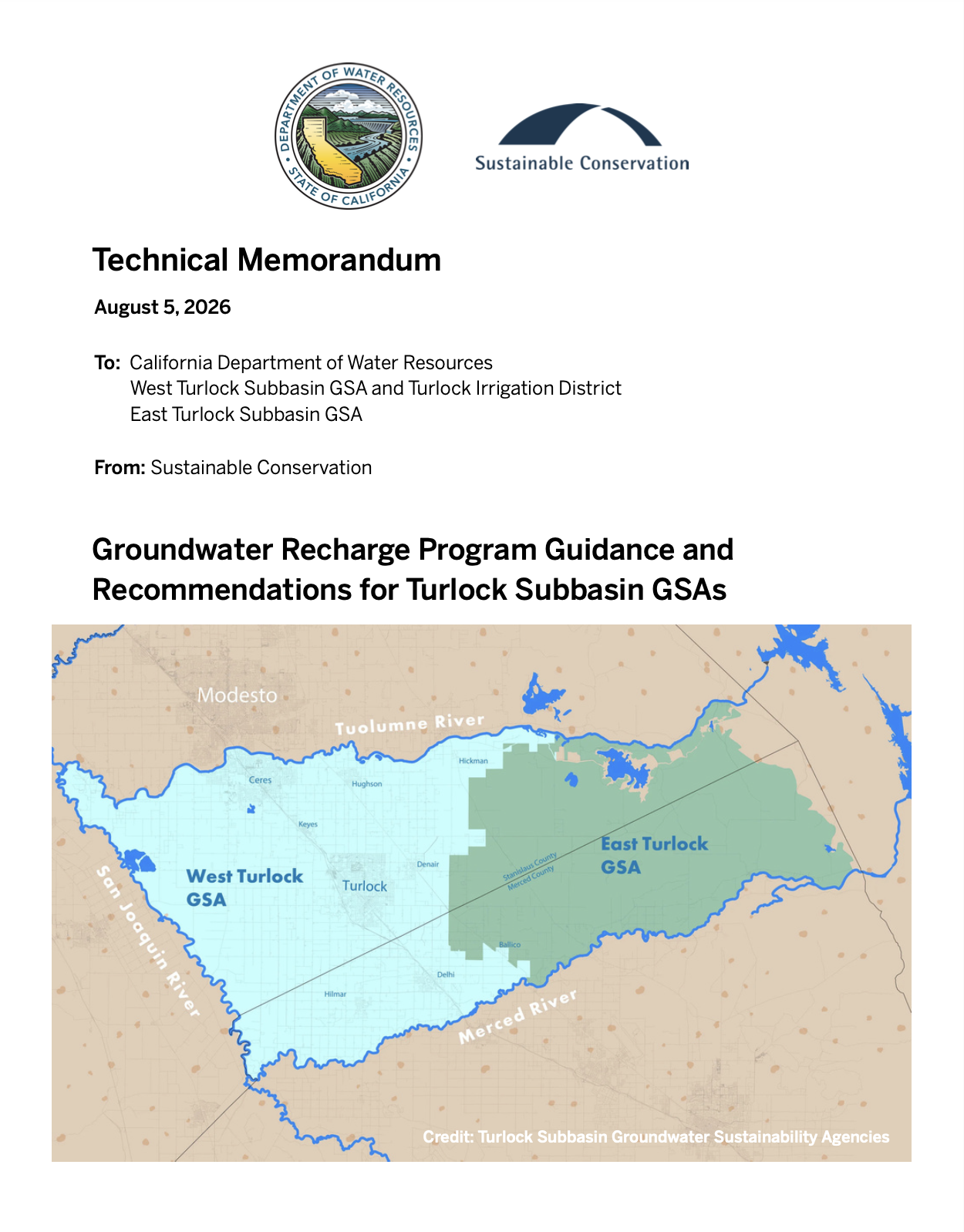
| Full Description | This technical memorandum, developed by Sustainable Conservation, highlights groundwater recharge strategies, tools, lessons learned, and recommendations from ongoing groundwater sustainability efforts in California’s Turlock Subbasin. The West Turlock Subbasin Groundwater Sustainability Agency (WTSGSA) and East Turlock Subbasin Groundwater Sustainability Agency (ETSGSA) jointly manage the subbasin under a single Groundwater Sustainability Plan, but face substantially different groundwater and surface water conditions. The memo explores how the two GSAs have developed complementary strategies that reflect these differences while working toward shared groundwater sustainability goals. These approaches include in-lieu and direct groundwater recharge, groundwater demand reduction, land repurposing, surface water purchases and conveyance improvements, and incentives for agricultural landowners. The resource also describes how technical tools and assistance have supported implementation. The Turlock Subbasin Groundwater Recharge Assessment Tool (GRAT) combines geophysical and hydrologic information with local water delivery systems to help identify suitable and cost-effective recharge locations and optimize available water for recharge. The tool has supported cross-GSA coordination and is being updated with information developed through DWR’s San Joaquin Basin Flood-MAR Watershed Studies and East Turlock’s Multibenefit Land Repurposing Program (MLRP). Drawing from experience with on-farm recharge pilots, TID’s Idle Lands Recharge Program, East Turlock’s MLRP, grower outreach, and technical assistance, the memo identifies opportunities to continue expanding recharge across the subbasin. Recommendations include adapting infrastructure and operations to changing hydrology, increasing on-farm and in-lieu recharge, improving surface water conveyance and storage, expanding grower participation, and using tools such as GRAT to target recharge investments and evaluate future projects. Together, these experiences offer a practical example of how GSAs with different water-supply conditions can coordinate recharge, demand management, land-use strategies, technical tools, and grower engagement to advance groundwater sustainability at the basin scale. |
 | |
| Topic Area(s) |
|