
| Title | On-Farm Recharge Methods Manual: A Summary of Strategies and Challenges |
|---|---|
| Resource Author(s) |
|
| Year of Publication | 2026 |
| Link to Report/Website | suscon.org |
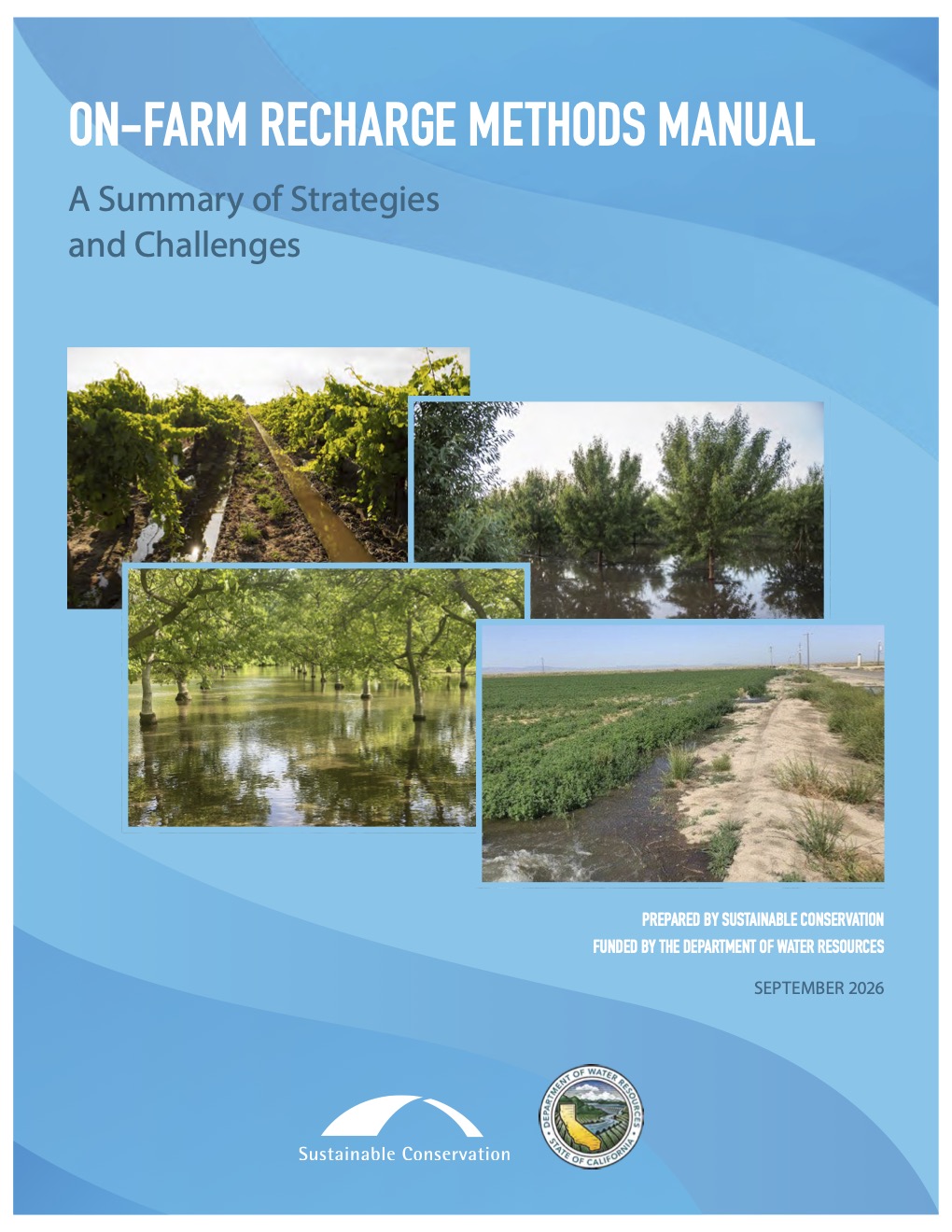
| Full Description | Sustainable Conservation’s *On-Farm Recharge Methods Manual: A Summary of Strategies and Challenges* (September 2026) provides practical information to help California growers evaluate, plan, and implement groundwater recharge on agricultural lands. Prepared with funding from the California Department of Water Resources, the manual draws on more than a decade of experience working directly with growers and irrigation districts. It brings together field observations, lessons learned, and available research to explain recharge opportunities, management approaches, and challenges. The manual describes how on-farm recharge can support groundwater sustainability, reduce flood risk, benefit groundwater-dependent ecosystems, and help sustain working lands. It walks readers through key planning considerations, including coordination with groundwater sustainability agencies and water districts, water rights and availability, conveyance infrastructure, soil and subsurface conditions, and groundwater quality protection. It also introduces mapping tools and other resources for assessing recharge suitability. Crop-specific sections discuss recharge considerations for vineyards, almonds, pistachios, walnuts, and alfalfa, along with opportunities on annual crop fields, fallow land, and dedicated recharge basins. Additional topics include cover crops, subsurface recharge, reverse tile drains, and adaptations to drip and sprinkler systems. Practical guidance addresses field preparation, berms, water application timing and duration, infiltration monitoring, and protecting crop health. Financial sections outline infrastructure, water, energy, and labor costs, as well as incentives and potential funding sources. An extensive appendix presents 23 case studies documenting recharge methods, site conditions, water supplies, field management, costs, and grower experiences. These examples illustrate how approaches vary across crops, soils, infrastructure, and local programs. The manual is intended primarily for growers interested in on-farm recharge and technical assistance providers, including resource conservation districts, crop advisors, and nonprofit organizations. It is also useful to water districts and groundwater sustainability agencies supporting grower participation. Throughout, it emphasizes tailoring recharge to local conditions and using field observations to guide management as scientific understanding continues to develop. |
 | |
| Topic Area(s) |
|